
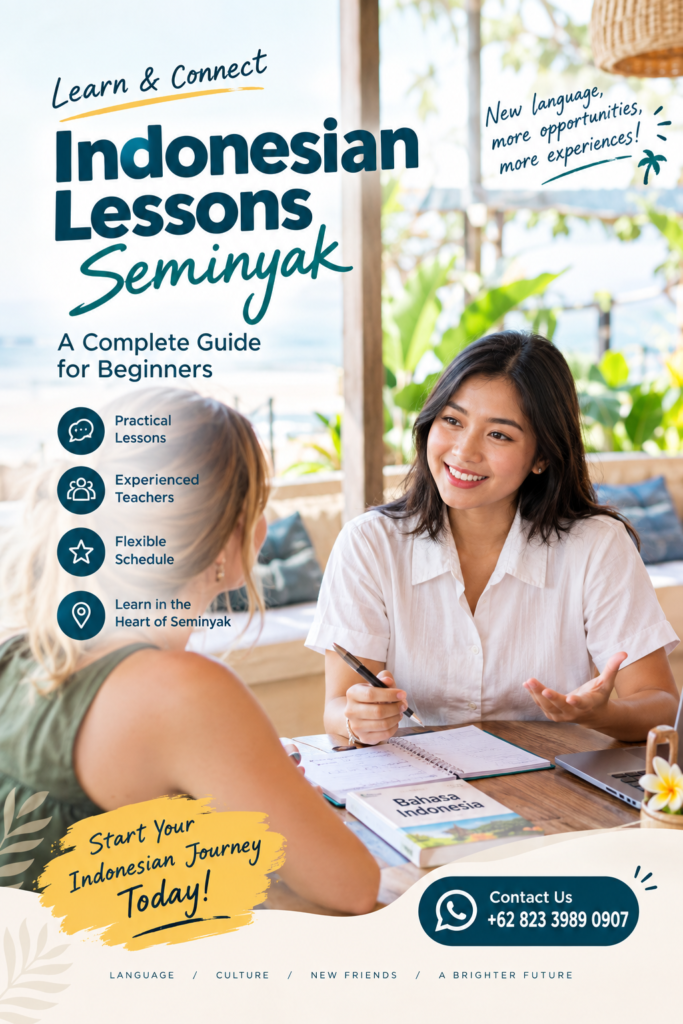
Learning Indonesian can make your experience in Bali more comfortable, meaningful, and enjoyable. Whether you plan to stay in Bali for a few weeks, live in Seminyak for several months, or simply want to communicate more naturally with local people, Indonesian lessons in Seminyak can give you a practical starting point.Seminyak offers a convenient environment for language learning because you can practice Indonesian in many everyday situations. For example, you can use simple Indonesian phrases when ordering food, shopping, speaking with local residents, asking for directions, or visiting nearby attractions.Moreover, Bahasa Indonesia serves as Indonesia’s national and official language. People use it throughout the country for official communication, education, media, and communication between people from different linguistic backgrounds. Visit Indonesia
In this guide, you will learn what Indonesian lessons in Seminyak can offer, what beginners should study first, and how you can improve your Indonesian through regular practice.
Why Learn Indonesian in Seminyak?
Seminyak gives you more than a classroom environment. The area provides many opportunities to hear and use Indonesian during your daily activities.For instance, you can practice ordering meals at a local restaurant, greeting staff at a shop, asking a driver for directions, or having a simple conversation with Indonesian speakers.In addition, Seminyak attracts international visitors and residents. The area combines accommodation, restaurants, shopping, beaches, and other tourism facilities. The official Indonesia Travel website describes Seminyak as a coastal area with a wide range of accommodation, dining, and tourism experiences. Visit Indonesia.Therefore, you can combine your Indonesian lessons with real-world practice.
Practice Indonesian Outside the Classroom
After your lesson, try using the vocabulary you have learned.For example:
- Say “Selamat pagi” when you greet someone in the morning.
- Ask “Berapa harganya?” when you want to know the price.
- Say “Terima kasih” after receiving help.
- Use “Permisi” when you want to get someone’s attention politely.
- Ask “Di mana…?” when you need to find a location.
The official Indonesia Travel language guide also provides several useful Indonesian expressions for travelers and beginners. Visit Indonesia
What Are Indonesian Lessons in Seminyak?
Indonesian lessons in Seminyak can help beginners develop practical language skills through structured learning and conversation practice.A good lesson should focus on more than memorizing vocabulary. Instead, you should learn how to use words and phrases in real conversations. For example, a beginner lesson may cover:
- Indonesian greetings
- Basic introductions
- Numbers and prices
- Food and drinks
- Asking for directions
- Shopping vocabulary
- Daily activities
- Common verbs
- Simple sentence structures
- Indonesian pronunciation
- Everyday conversations
- Indonesian culture and etiquette
As you progress, your teacher can introduce more complex vocabulary and grammar.
Who Can Take Indonesian Lessons in Seminyak?
Indonesian lessons can suit many different types of learners.
1. Tourists
Tourists can learn basic Indonesian phrases before or during their Bali trip. Even a small vocabulary can make everyday interactions easier.
2. Expats
Expats who live in Seminyak can benefit from regular Indonesian lessons because they often communicate with local staff, neighbors, drivers, restaurants, and businesses.
3. Digital Nomads
Digital nomads can use Indonesian lessons to improve their communication while living and working in Bali.
4. Long-Term Visitors
If you plan to stay in Bali for an extended period, learning Indonesian can help you communicate more independently.
5. Complete Beginners
You do not need previous Indonesian language experience. A teacher can start with basic vocabulary and gradually introduce more complex language patterns.
What Will You Learn in Indonesian Lessons Seminyak?
A structured course can take you through Indonesian step by step.
Basic Indonesian Greetings
Greetings provide an excellent starting point because you can use them immediately.Some common examples include:
- Selamat pagi — Good morning
- Selamat siang — Good afternoon
- Selamat sore — Good late afternoon
- Selamat malam — Good evening/night
- Apa kabar? — How are you?
- Terima kasih — Thank you
- Sama-sama — You’re welcome
- Permisi — Excuse me
- Maaf — Sorry
The official Indonesia Travel guide also lists these expressions as useful Indonesian phrases for visitors. Visit Indonesia
Introducing Yourself
Next, you can learn how to introduce yourself.
For example:
Nama saya John.
My name is John.
You can then add information about where you come from:
Saya dari Australia.
I am from Australia.
You can also ask another person:
Siapa nama Anda?
What is your name?
These simple sentences allow you to start basic conversations quickly.
Learn Indonesian Numbers and Prices
Numbers play an important role in everyday communication.You may need Indonesian numbers when you shop, order food, pay for transportation, or discuss prices.Start with simple numbers:
- Satu — One
- Dua — Two
- Tiga — Three
- Empat — Four
- Lima — Five
- Enam — Six
- Tujuh — Seven
- Delapan — Eight
- Sembilan — Nine
- Sepuluh — Ten
Then learn useful questions such as: “Berapa harganya?”
How much does it cost? This phrase can help you communicate more confidently when shopping or ordering something.
Improve Your Indonesian Conversation Skills
Vocabulary alone cannot make you a confident speaker. Therefore, you should practice using your vocabulary in complete sentences. For example, instead of only memorizing the word makan meaning “eat,” practice a sentence:
Saya mau makan.
I want to eat.
You can then expand the sentence:
Saya mau makan nasi goreng.
I want to eat fried rice.
After that, you can create a question:
Anda mau makan apa?
What do you want to eat?
This approach helps you understand how Indonesian works in real conversations.
Indonesian Pronunciation for Beginners
Many beginners worry about Indonesian pronunciation. However, Indonesian pronunciation can feel relatively approachable because spelling often provides useful clues about pronunciation. For example:
- a generally sounds like the “a” in father
- i generally sounds like the “ee” in see
- u generally sounds like the “oo” in food
Nevertheless, listening practice remains important. A teacher can help you improve pronunciation by correcting individual sounds and encouraging you to repeat natural phrases
Learn Indonesian Through Real-Life Situations
One of the most effective ways to improve your Indonesian involves connecting lessons with daily activities. For example, after learning restaurant vocabulary, visit a local restaurant and practice ordering in Indonesian.
You can say:
Saya mau nasi goreng, satu.
Then try:
Saya mau air putih, satu.
You can also ask:
Boleh minta menu?
These small interactions can gradually increase your confidence. Furthermore, you can practice Indonesian while exploring Seminyak. The area offers beaches, restaurants, accommodation, shopping, and other tourism activities, which gives learners many everyday situations where they can use Indonesian. Visit Indonesia
Private Indonesian Lessons vs. Group Lessons
Beginners can choose between private and group lessons depending on their learning preferences.
Private Indonesian Lessons
Private lessons allow the teacher to focus directly on your needs. For example, you can ask your teacher to focus on:
- Conversation
- Pronunciation
- Grammar
- Travel vocabulary
- Business Indonesian
- Everyday Indonesian
- Indonesian for expats
Private lessons can also allow you to move through the material at a pace that suits you.
Group Indonesian Lessons
Group lessons allow you to practice with other learners. As a result, you can experience different speaking styles and participate in group conversations.Group learning can also create opportunities to practice listening and responding in a more social environment. Ultimately, your choice should depend on your goals, schedule, and preferred learning style.
How Long Does It Take to Learn Indonesian?
The answer depends on several factors. Your progress can depend on:
- How frequently you study
- How much Indonesian you use outside class
- Your previous language-learning experience
- How much vocabulary you practice
- How often you speak with Indonesian speakers
- Your personal learning goals
For example, someone who attends regular lessons and practices Indonesian every day may develop conversational skills faster than someone who only studies occasionally. Therefore, consistency matters more than simply attending a lesson once in a while.
Tips for Learning Indonesian Faster
You can improve your progress by combining Indonesian lessons with daily practice.
1. Practice Every Day
Spend at least a few minutes using Indonesian each day.
2. Speak From the Beginning
Do not wait until you know perfect grammar. Start with simple sentences and gradually improve them.
3. Learn Useful Vocabulary
Focus on words that you can use in your daily life.
4. Listen to Indonesian
Listen to conversations, videos, podcasts, or Indonesian speakers to become familiar with natural pronunciation.
5. Keep a Vocabulary Notebook
Write down new words and create example sentences.
6. Practice Outside Your Lessons
Use Indonesian when you order food, shop, greet people, or ask simple questions.
7. Ask Your Teacher for Corrections
Regular feedback can help you identify mistakes and improve your speaking skills.
Indonesian Language and Local Culture
Language learning also gives you an opportunity to understand Indonesian culture. Although Bahasa Indonesia functions as the national language, Bali also has its own local language and cultural traditions. Indonesia Travel explains that Bahasa Indonesia plays an important role in formal and cross-cultural communication in Bali, while Balinese remains important in local social and cultural settings. Visit IndonesiaTherefore, learning Indonesian can help you communicate across different communities while also giving you a better understanding of the cultural environment around you.
Pingback: Indonesian Lessons Seminyak: Learn Indonesian While Experiencing Bali - Seminyak Language School