
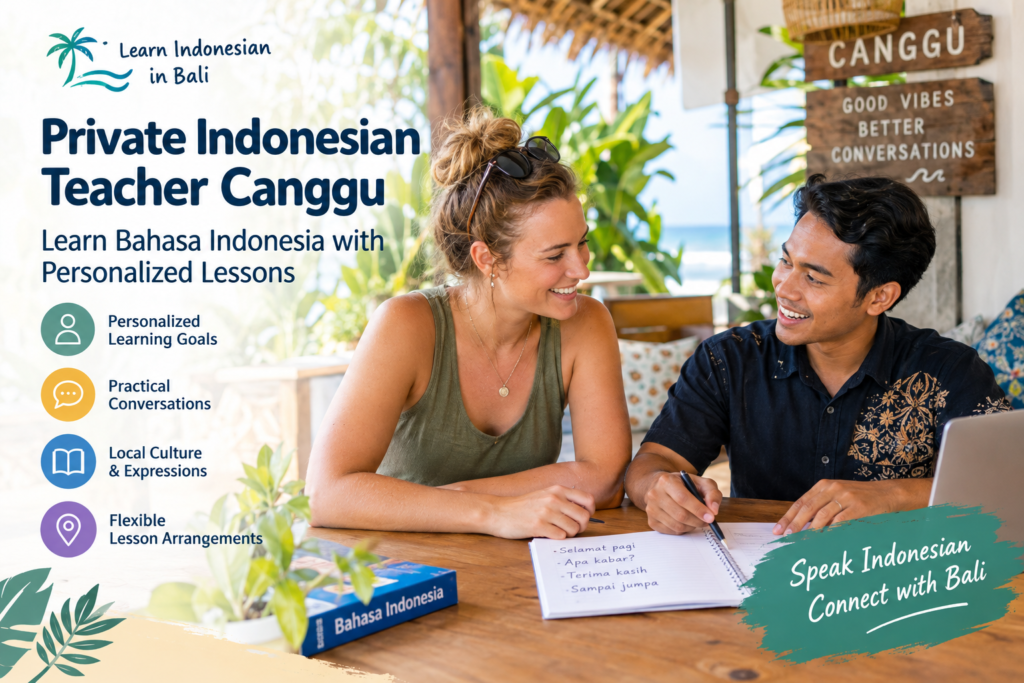
Are you looking for a private Indonesian teacher in Canggu who can help you communicate more confidently in Bali? Learning Bahasa Indonesia can make everyday life easier, whether you live in Canggu as an expat, work remotely as a digital nomad, or spend an extended holiday on the island. Moreover, learning the local language allows you to connect with Indonesian speakers and understand the culture more deeply. Although many people in Canggu speak English, Indonesian remains essential for daily interactions throughout Bali. For example, you may want to order food, talk to local shop owners, ask for directions, or build friendships with Indonesian neighbors. Therefore, learning practical Indonesian can help you feel more comfortable and independent.A private lesson offers an opportunity to focus on your personal goals, current language level, and preferred learning style. Instead of relying only on memorization, you can practice useful expressions, develop listening skills, and learn how Indonesians communicate in everyday situations. With the right learning approach, you can gradually build your vocabulary and improve your ability to communicate naturally.
Why Choose a Private Indonesian Teacher in Canggu?
Choosing a private Indonesian teacher in Canggu can make your learning experience more personal and goal-oriented. Rather than following a one-size-fits-all approach, you can focus on the language skills that matter most to your daily life.
1. Personalized Learning Goals
Every learner has different reasons for studying Indonesian. For instance, a beginner may want to learn basic greetings, while an expat may need vocabulary for shopping, renting accommodation, or communicating with local service providers.A personalized learning plan helps you focus on these priorities. Furthermore, your teacher can adjust activities as your vocabulary, comprehension, and confidence improve.
2. Individual Attention and Feedback
When you learn privately, you have more opportunities to ask questions and practice speaking. Your teacher can identify common mistakes, explain unfamiliar expressions, and provide feedback that matches your level.As a result, you can spend more time working on areas that need improvement instead of repeating material you already understand.
3. Practical Speaking and Listening Practice
Speaking a new language requires more than memorizing vocabulary. You also need to understand questions, recognize familiar expressions, and respond appropriately.For this reason, practical conversation exercises are valuable. You can practice realistic situations, such as ordering a drink, introducing yourself, or asking someone for help.
4. Flexible Learning Arrangements
Expats and digital nomads often have changing schedules. Consequently, lesson arrangements that consider your availability can make it easier to maintain a consistent learning routine, subject to the provider’s scheduling options. You can also discuss your preferred learning pace and areas of interest before beginning a program. To explore available learning options, visit our Indonesian language program.
Benefits of Learning Bahasa Indonesia While Living in Canggu
Canggu attracts international residents, remote workers, travelers, and people interested in Bali’s lifestyle. However, learning Indonesian can help you experience the area beyond its international cafés, coworking spaces, and popular beaches.
Communicate More Comfortably in Everyday Situations
Simple Indonesian phrases can make daily interactions easier. For example, learning how to greet someone politely can help you start conversations with local residents.
Here are several useful expressions for beginners:
- Selamat pagi — Good morning.
- Apa kabar? — How are you?
- Terima kasih — Thank you.
- Tolong — Please or help, depending on the context.
- Berapa harganya? — How much does it cost?
- Permisi — Excuse me.
- Saya sedang belajar bahasa Indonesia — I am learning Indonesian.
Although these expressions are simple, they can help you participate in everyday conversations. Moreover, using Indonesian shows that you are making an effort to communicate with people in their language.
Build Better Connections with Local Communities
Language can help you create more meaningful relationships. For instance, you can introduce yourself to neighbors, chat with shop owners, or learn more about local customs. Furthermore, understanding common expressions can help you recognize the difference between formal and informal communication. This knowledge becomes especially useful when you interact with people of different ages or social backgrounds.
Understand Local Culture More Deeply
Language and culture are closely connected. By learning Indonesian, you can discover how people express politeness, gratitude, respect, and friendliness. For example, you may encounter different greetings and forms of address depending on the situation. A teacher can explain these differences and help you choose appropriate expressions. Consequently, learning Bahasa Indonesia becomes more than a language exercise. It also becomes a way to understand the people and communities around you.
What Can You Learn with a Private Indonesian Teacher in Canggu?
A structured learning program can help you develop several language skills. However, the topics you study should reflect your current level and personal objectives.
Everyday Indonesian Conversations
Conversation practice helps you use Indonesian in realistic situations. Instead of studying isolated words, you learn how to combine them into meaningful sentences.
For example, you can practice:
- Introducing yourself and meeting new people.
- Ordering meals and drinks at local restaurants.
- Asking for directions and understanding simple answers.
- Shopping at traditional markets and local stores.
- Discussing your work, hobbies, and daily routine.
- Making appointments and asking for assistance.
Furthermore, repeating these situations can help you respond more naturally over time. Your teacher can introduce new vocabulary gradually as you become more comfortable with familiar conversations.
Indonesian Pronunciation and Listening Skills
Understanding spoken Indonesian is an important part of effective communication. Although Indonesian uses the Latin alphabet, you still need practice recognizing natural speech, familiar sound patterns, and words spoken at different speeds. A teacher can help you listen to examples, repeat useful expressions, and identify pronunciation mistakes. In addition, guided conversation practice allows you to hear how vocabulary works in context. As your listening skills improve, you may find it easier to understand everyday questions and respond without translating every word into English.
Practical Grammar and Vocabulary
Grammar helps you form meaningful sentences. Nevertheless, you do not need to memorize every rule before you begin speaking. For example, you can learn basic sentence patterns through familiar activities:
- Saya tinggal di Canggu. — I live in Canggu.
- Saya mau makan. — I want to eat.
- Saya bekerja dari rumah. — I work from home.
- Saya tidak mengerti. — I do not understand.
These examples introduce useful vocabulary and sentence structures. Moreover, a teacher can explain how to change words and phrases to express different needs. As a result, you can build a practical foundation and gradually expand your ability to discuss more complex topics.
Indonesian Culture and Local Expressions
Indonesian communication involves more than vocabulary and grammar. Tone, context, politeness, and the relationship between speakers can also influence how people communicate. For instance, a phrase that sounds natural among friends may not be the best choice in a formal conversation. Therefore, understanding context helps you choose suitable expressions. A culturally informed lesson can also introduce everyday customs, common greetings, and expressions that you may encounter while living in Bali.
Personalized Indonesian Lessons for Expats and Digital Nomads
A private Indonesian teacher in Canggu can help learners with different backgrounds and goals. Whether you are staying in Bali for a few weeks or planning to live here for several years, your learning priorities may change over time.
For Complete Beginners
If you have never studied Indonesian, start with greetings, numbers, pronunciation, and simple sentence patterns. These fundamentals provide a useful foundation for everyday communication. Next, practice introducing yourself, asking basic questions, and understanding common responses. With regular practice, you can gradually expand your vocabulary and become more comfortable using Indonesian.
For Intermediate Learners
If you already understand basic Indonesian, focus on expanding your vocabulary and developing longer conversations. For example, you can practice explaining your opinions, discussing your daily routine, describing past experiences, and asking more detailed questions. Furthermore, targeted feedback can help you recognize recurring mistakes and express your ideas more clearly.
For Expats and Long-Term Residents
People who live in Bali often need Indonesian for practical situations. You may want to communicate with neighbors, discuss household services, speak with local businesses, or understand everyday announcements. Therefore, lessons built around your routine can make your learning more relevant and immediately useful.
For Digital Nomads
Remote workers may want to learn vocabulary related to accommodation, transportation, cafés, coworking spaces, and social activities. Although many professional environments in Canggu use English, Indonesian can help you communicate beyond those settings. Consequently, you may feel more confident exploring local communities and building relationships. To understand how a structured program can support these goals, explore our Indonesian learning curriculum.
How Our Indonesian Language Program Works
Choosing the right learning program begins with understanding your current level and what you want to achieve. For example, you might prioritize everyday conversations, practical vocabulary, pronunciation, or a broader understanding of Indonesian grammar. A structured program can help organize these goals into manageable learning stages. In addition, clear learning objectives make it easier to review your progress and identify the topics you should practice next. When exploring a program, consider the teaching format, lesson content, available resources, and scheduling arrangements. These factors can help you decide whether the program suits your needs.
You can explore our Indonesian language program to learn more about the available learning options.
A Practical and Engaging Method for Learning Indonesian
An effective language-learning method combines explanation with active practice. Instead of only reading vocabulary lists, you can learn new expressions and immediately use them in conversations. For example, a lesson about ordering food can introduce menu vocabulary, polite requests, and questions about prices. Afterwards, a role-play exercise can help you practice ordering a meal in a realistic situation.Similarly, a lesson about directions can teach you how to ask where a location is and understand a simple response.
Moreover, reviewing previous material helps reinforce your memory. By combining repetition, listening, speaking, and practical examples, you can build a more consistent learning routine. Discover more about our Indonesian teaching method to understand the approach used in your learning journey.
Experience Indonesian Through Sample Lessons
Before choosing a learning program, you may want to understand how a lesson works. Sample lessons can provide a useful introduction to the teaching style, language activities, and learning materials. For instance, you might explore how a lesson introduces new vocabulary, explains sentence patterns, and encourages students to practice speaking.Additionally, sample materials can help you decide whether the learning approach matches your and current ability. This step is particularly helpful for beginners because it provides a clearer idea of what to expect. Meanwhile, intermediate learners can look for examples that match their existing knowledge and learning objectives.
Take a look at our Indonesian sample lessons to explore the learning experience.
What Do Students Say About Learning Indonesian?
Student feedback can help you understand other learners’ experiences and expectations. Reviews may offer useful perspectives on teaching style, lesson structure, and the overall learning process. However, every learner has different goals and preferences. Therefore, you should consider your own objectives when evaluating whether a language program is suitable for you. For example, a beginner may prioritize clear explanations and basic conversation practice, while an intermediate learner may prefer more challenging discussions.
Reading authentic feedback can help you make a more informed decision. You can read student reviews to learn more about other students’ experiences.
How to Choose the Right Private Indonesian Teacher in Canggu
Finding a suitable teacher involves more than choosing the closest available option. Instead, consider how the teaching approach aligns with your goals, schedule, and preferred learning style.Here are several factors to evaluate before starting your lessons.
- 1. Identify your learning goals. Decide whether you want to focus on everyday conversations, pronunciation, grammar, or communication for work and daily life.
- 2. Check the learning structure. Look for clear lesson objectives and a logical progression from basic concepts to more advanced skills.
- 3. Consider speaking opportunities. Regular conversation practice can help you apply new vocabulary and recognize areas that need improvement.
- 4. Review the learning materials. Practical examples and relevant exercises can make lessons easier to apply outside the classroom.
- 5. Discuss your schedule. If you have a busy routine, ask about available lesson times and arrangements before committing to a program.
- 6. Understand the fees and program details. Ask for clear information about pricing, lesson duration, and what the program includes.
- 7. Look for a suitable teaching style. Choose an approach that encourages questions, provides constructive feedback, and supports your learning objectives.
Ultimately, the right choice depends on your needs and the learning experience you prefer. Taking time to compare your options can help you begin with realistic expectations.
Start Learning Bahasa Indonesia in Canggu
Learning Indonesian can make everyday life in Bali more engaging. From greeting local residents to asking questions at a market, even a small amount of language knowledge can help you communicate more comfortably. Furthermore, regular practice can help you develop stronger listening skills, expand your vocabulary, and understand the cultural context behind common expressions. If you are looking for a private Indonesian teacher in Canggu, begin by identifying your learning goals and exploring the available program options. Consider which skills matter most to you, then choose a learning approach that supports those priorities.
You do not need to master the language immediately. Instead, focus on steady progress, practical conversations, and consistent practice.Ready to take the next step? Visit Learn Indonesian in Bali to discuss your Indonesian learning goals and explore the options that may suit you.
Start learning today and build the confidence to communicate more naturally with people throughout Bali.
Frequently Asked Questions
1. Why should I choose a private Indonesian teacher in Canggu?
A private teacher can help you focus on your personal learning goals, receive individual feedback, and practice conversations relevant to your daily life. Moreover, personalized lessons can adapt to your current level and areas for improvement. This approach can be useful for expats, digital nomads, and international residents who want practical Indonesian skills.
2. Can complete beginners learn Bahasa Indonesia with a private teacher?
Yes. Beginners can start with greetings, pronunciation, numbers, basic vocabulary, and simple sentences. Gradually, they can practice introductions, everyday questions, and common conversations. A structured approach helps learners develop their skills step by step without needing previous experience in Indonesian.
3. How long does it take to learn basic Indonesian conversations?
The time required depends on your starting level, practice frequency, learning goals, and exposure to Indonesian outside lessons. With consistent practice, many learners can begin using simple expressions relatively early. However, conversational confidence develops at different rates, so it is best to set realistic goals and review your progress regularly.
4. What topics can I study during private Indonesian lessons?
Topics may include everyday conversations, pronunciation, listening, grammar, vocabulary, and cultural expressions. You can also focus on practical situations such as ordering food, shopping, asking for directions, or communicating with neighbors. The most suitable topics depend on your current level and personal objectives.
5. Can Indonesian lessons be adapted to my personal learning goals?
Personalized lessons can focus on specific needs, such as daily communication, travel, long-term residence, or social interactions. Before starting, explain your goals and discuss the learning structure with the provider. This helps you determine whether the available program matches your expectations and preferred learning style.
6. How can I find out which Indonesian learning program suits me?
Start by reviewing the program information, curriculum, teaching method, and sample lessons. These resources can help you understand the learning structure and decide whether it suits your goals. You can also contact the provider to ask about lesson arrangements, fees, and suitable options for your current level.
7. How do I contact Learn Indonesian in Bali?
Visit the Learn Indonesian in Bali contact page to find the available contact information. You can explain your current Indonesian level, learning goals, and preferred schedule. This information can help you discuss suitable program options before beginning your language-learning journey.